Solved Precis Paper of 2025

PART-I (MCQs)
(a) Choose the word that is nearly most similar in meaning to the capitalized words.
1. FRABJOUS:
(A) Wonderful (B) Surprising (C) Blithe (D) Gusto
2. ACCUBATION:
(A) Conversation (B) Reclining (C) Ambulation (D) Occupation
3. LEVITATE:
(A) Sink (B) Float (C) Plod (D) Wander
4. SIBYLLINE:
(A) Enigmatic (B) Obvious (C) Transparent (D) Subtle
5. MACADAMIZED:
(A) Graveled (B) Mudded (C) Turfed (D) Paved
6. FINAGLE :
(A) Surrender (B) Manipulate (C) Cooperate (D) Wheedle
7. DESIDERIUM:
(A) Craving (B) Satisfaction (C) Fulfillment (D) Contentment
8. AMANUENSIS:
(A) Secretary (B) Assistant (C) Clerk (D) Scribe
9. CROMULENT:
(A) Acceptable (B) Unacceptable (C) Questionable (D) Dubious
10. PROPINQUITY:
(A) Distance (B) Closeness (C) Remoteness (D) Isolation
(b) Choose the word that is nearly most opposite in meaning to the capitalized words.
11. PERSPICACITY:
(A) Acumen (B) Astuteness (C) Naivety (D) Intelligence
12. CONFABULATION:
(A ) Verification (B) Fabrication (C) Distortion (D) Exaggeration
13. DILENTTANTE:
(A) Amateur (B) Connoisseur (C) Novice (D) Enthusiast
14. KILTER:
(A) Balance (B) Order (C) Harmony (D) Out-of-sync
15. RHUBARB:
(A) Serenity (B) Cacophony (C) Harmony (D) Sweetness
16. CORUSCATING:
(A) Mundane (B) Tenebrous (C) Sparkling (D) Brilliant
17. VELLEITY:
(A) Aversion (B) Passion (C) Indifference (D) Apathy
18. BAROQUE:
(A) Minimalist (B) Ornate (C) Classical (D) Rococo
19. CAVEAT:
(A) Guarantee (B) Warning (C) Assurance (D) Disclaimer
20. BLUSTER:
(A) Bravado (B) Boast (C) Confidence (D) Meekness
ENGLISH (PRECIS & COMPOSITION) PART-II
Q. 2. Distil the passage into a précis and suggest an apt title. (20)
Homi K. Bhabha, a prominent postcolonial scholar, advances a profoundly philosophical yet grounded concept of nationalism, positing that "Nations, like narratives, lose their origins in the myths of time and only fully encounter their horizons in the mind's eye," thereby highlighting the complex interplay between the imagined, the mythical, and the material in the construction of national identity. Nations, like narratives, are constructed through historical contingency, shaped by ethnic obsessions and regional affiliations that often obscure their origins. As a result, national identities can become rigid and exclusionary, antagonizing the notion of humanism envisioned by ancient philosophers like Socrates and Plato. This idea has implications for our understanding of humanism, a cornerstone of intellectual traditions from Goethe and Rousseau's emphasis on the universal human experience to AlGhazali and Ibn Rushd's advocacy for reason and compassion as bridges between cultures.Al-Ghazali's "The Alchemy of Happiness" strikes a balance between promoting local identity and warning against provincial, insular nationalism, making him a votary of cultural exchange and understanding. He advocates for an evenhanded approach, balancing love for one's land with justice for all citizens. In "The Revival of Religious Sciences," Al-Ghazali emphasizes balancing universalism and particularism, recognizing that national identity must be tempered by justice and equality. By promoting inclusive citizenship, Al-Ghazali offers an antidote to exclusivist nationalist ideologies. By exploring the intersections between nationalism and humanism, Bhabha's work also encourages us to think critically about how national identities are constructed and imagine new forms of global citizenship prioritizing shared humanity over narrow national interests. However, the rise of nationalism has often led to a narrowing of perspectives, prioritizing regional affiliations over universal values, resulting in a stringent and macho form of patriotism that stifles dissent and creativity. Like a chameleon, nationalism can adapt and change, often blurring the lines between patriotism and xenophobia. Altogether, nationalism is not a bane, its mixed benefits over the last century have been a double-edged sword, yielding a staggering array of positive and negative consequences. On one hand, nations have become increasingly aware of the need to align themselves with pluralism and egalitarian schemes. However, the desire to dominate, as exemplified by the German geographer Friedrich Ratzel's idea of organic borders, continues to have a silent appeal, often manifesting in bizarre and violent forms, such as the recent bloodshed in Palestine and the earlier Bosnian massacre. This scary trail is long and hard to absorb, especially when democracy itself has been exposed as a mere façade, leaving many to blurt out frustrations and disillusionments. As the philosopher Allama Iqbal aptly put it in his famous poem, "The Devil's Parliament," democracy is merely the outer crust, while the essence is imperialist. Iqbal's words ring true, warning us against the uncritical subservience and adoration of nationalism, which can lead to historical myopia, strengthening dictatorial hegemony and incarcerating the human spirit within the narrow confines of love for the land. Perhaps democracy is the safest carrier of the seed of nationalism, transporting it under the guise of economic equality. Still, weaker nations face the political bravado of the powerful leaving the meager nations to be content with mere paeans of love for border and territorial integrity. Imperialism planted the embryo of nationalism, abandoning the wretched children of the earth to fend for themselves, left to navigate the treacherous waters of self-determination. The power of nationalism is a potent form of Volksgeist - a term coined by Johann Gottfried Herder to describe a nation's unique spirit or character - that can be both unifying and divisive, depending on how it is wielded. In this context, a more frugal and nuanced approach to nationalism is needed, one that balances national pride with a commitment to universal values and human rights.
Title:
Nationalism as a Double-Edged Sword
Precis
Homi K. Bhabha presents nationalism as a historical and ideological construct shaped by myths, social conditions, and evolving human perceptions rather than fixed origins. While nationalism can foster unity and collective identity, it often becomes exclusionary and conflicts with the universal humanism advocated by philosophers across civilizations. Thinkers such as Al-Ghazali emphasized maintaining a balance between love for one’s homeland and justice, promoting inclusivity and cultural exchange to prevent extreme nationalism. Historically, nationalism has produced both constructive and destructive outcomes. It has encouraged solidarity and political awareness, yet it has also fueled conflict, domination, and intolerance, as reflected in various global struggles. Imperialism played a major role in shaping nationalist movements, frequently leaving weaker nations struggling for genuine self-determination. Moreover, democracy, though seen as a vehicle of equality, can sometimes conceal imperial ambitions, a concern highlighted by Allama Iqbal. In its extreme form, nationalism suppresses dissent, limits intellectual freedom, and promotes expansionist ambitions. Herder’s concept of Volksgeist illustrates nationalism’s potential to unite people through shared identity while also warning of its divisive consequences when taken to excess. Therefore, nationalism must be approached with caution and balance, combining national pride with justice, human rights, and universal human values to promote harmony rather than division.
Q. 5. (a) Punctuate the following text where necessary. (05)
In Pakistani folklore Heer Ranjha Sohni Mahiwal and Sassi Punnu are iconic tales of star-crossed lovers. These stories deeply rooted in tribal connections serve as allegories and commentaries on spiritual and romantic love they explore the complexities of human emotion the trials of love and the transformative power of spiritual elevation The themes of trial emotional anguish separation and expulsion resulting in the moral polishing of the lovers are timeless and universal... Heer Ranjha's epic tale penned by Waris Shah is a masterpiece of Punjabi literature a testament to the power of love to transcend mortal bounds.
Solution :
In Pakistani folklore, Heer Ranjha, Sohni Mahiwal, and Sassi Punnu are iconic tales of star-crossed lovers. These stories, deeply rooted in tribal connections, serve as allegories and commentaries on spiritual and romantic love. They explore the complexities of human emotion, the trials of love, and the transformative power of spiritual elevation. The themes of trial, emotional anguish, separation, and expulsion, resulting in the moral polishing of the lovers, are timeless and universal. Heer Ranjha's epic tale, penned by Waris Shah, is a masterpiece of Punjabi literature—a testament to the power of love to transcend mortal bounds.
Q. 7. Translate the following into English by keeping in view figurative/idiomatic expressions. (10)
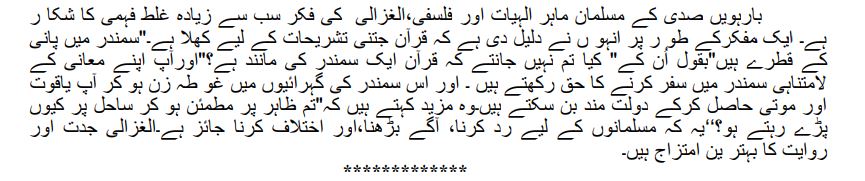
The philosophy of Al-Ghazali has been the most misunderstood. As a thinker, he argued that the Quran is vast enough to allow countless interpretations. “There are drops of water in the ocean,” he said. “Do you not know that the Quran is like an ocean?” And you have the right to journey through this infinite ocean of meanings. By diving into its depths, you can obtain rubies and pearls, becoming wealthy. He further asks, “Why do you remain content on the shore, satisfied with the surface?” This implies that for Muslims, it is permissible to question, to progress, and to differ. Al-Ghazali represents the best blend of innovation and tradition.