Pakistan’s IPP Crisis: The Power Deals Haunting Millions
Pakistan's IPP Crisis:
The Power Deals Haunting Millions
How three decades of flawed electricity contracts became the most expensive mistake Pakistan ever made — and who is still paying for it.
Original Research · Sources: Dawn, Al Jazeera, IEEFA, ISSI, The Nation, Express Tribune ·
What Are IPPs — And Why Were They Created?
In the early 1990s, Pakistan faced a growing problem. The country's electricity demand was rising fast, but the government-owned power utility — WAPDA — could not keep up. Factories needed more power. Cities were expanding. The government did not have enough money to build new power plants on its own.
So it turned to the private sector. The idea was simple: invite private companies — both local and foreign — to build power plants and sell electricity to the government. These companies became known as Independent Power Producers, or IPPs.
Definition :
An IPP (Independent Power Producer) is a private company that builds and operates a power plant. It sells electricity to the government under a long-term contract called a Power Purchase Agreement (PPA). The government is then obligated to pay the IPP — sometimes even if the electricity is never used.
Pakistan's 1994 Power Policy opened the floodgates. The government offered extremely generous terms to attract investors. The Hub Power Company (HUBCO) — established in 1991 — was the first, and became a landmark deal celebrated by global investors. The terms of the HUBCO deal were so attractive that they became the template for Pakistan's entire 1994 policy.
A second wave came with the 2002 Power Policy, and a third — even larger — wave arrived through the China-Pakistan Economic Corridor (CPEC) after 2015, when dozens of Chinese-backed power plants were added to the grid.
Here is what made these deals extraordinary — for the investors:
- A guaranteed profit of 15–18% return on investment every year, paid in US dollars
- Contracts lasting 25 to 30 years with sovereign guarantees from the Government of Pakistan
- Payment for capacity — meaning the government had to pay whether electricity was produced or not
- Projects could be built with up to 80% debt financing, minimizing investor risk
- Tariffs were calculated using a "cost-plus" model — the more a company spent, the more it earned
For investors, it was a dream. For Pakistan, it was a trap — one that would take decades to fully reveal itself.
Section 02
The Scale of the Problem — By the Numbers
Pakistan currently has 88 operational IPPs with a combined capacity of over 20,700 megawatts. When you include all thermal power plants, the number of privately operated plants crosses 74. The total installed electricity generation capacity of Pakistan as of 2025 stands at 46,605 MW — enough power, on paper, to light up the entire country.
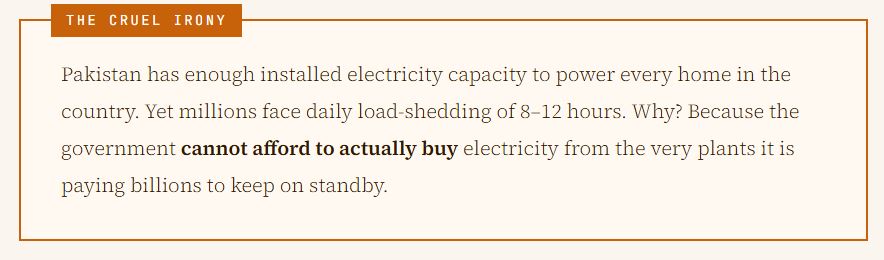
But here is the brutal irony: Pakistan is generating far less electricity than it is capable of. And yet it is still paying full price for the capacity it is not using.
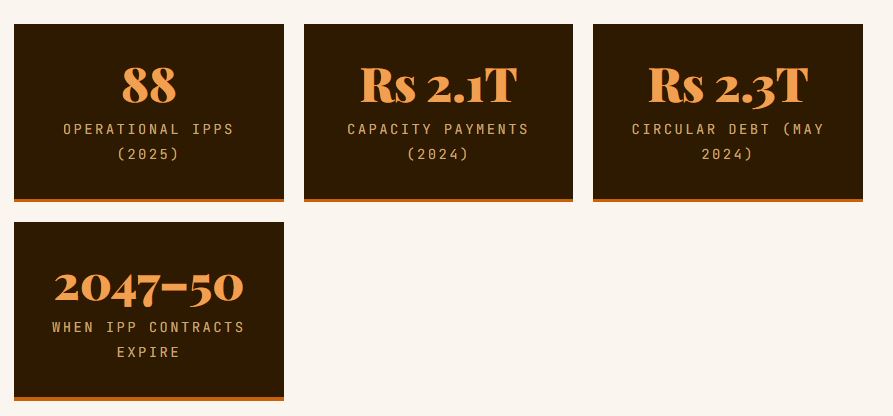
The term you need to understand here is "capacity payment." This is money paid to an IPP simply for having a power plant available — regardless of whether it actually generates electricity. In 2024, Pakistan paid a staggering Rs 2.1 trillion in capacity payments alone. That works out to roughly Rs 17.31 per kilowatt-hour just in fixed charges — before a single electron is even produced.
| Year / Period | Capacity Payments Paid | Key Context |
|---|---|---|
| FY 2022–23 | Rs 472 billion (to 17 IPPs) | Plus Rs 133.5 billion in interest to 9 major IPPs |
| FY 2023–24 | Rs 979.3 billion (to 33 IPPs) | IPPs produced less electricity but received more money |
| FY 2024–25 | Rs 2.1 trillion (projected) | Triggered IMF-directed renegotiations |
| Cumulative consumer burden | Rs 2.5–2.8 trillion/year | Paid to IPPs that often don't generate a single unit |
To put it plainly: Pakistan is paying the equivalent of two full federal budgets every year just to keep private power companies satisfied — many of whom are not even running their plants at full capacity.
Section 03
How IPP Owners Turned Policy Into Profit
The deals signed under the 1994 and 2002 power policies were not just generous — they were, critics argue, deliberately one-sided. Here is how IPP owners maximized their advantage:
- Dollar-denominated payments: As the Pakistani rupee lost value over the years, the cost of paying IPPs in dollar terms exploded for the government
- No efficiency incentive: Under the "cost-plus" model, companies had no reason to reduce costs — higher spending meant higher profits
- Guaranteed payments regardless of output: Two-thirds of what Pakistan pays an IPP is in fixed charges, not for actual electricity generated
- Allegations of over-invoicing: According to IEEFA, IPPs allegedly profited by under-reporting efficiency gains and inflating invoices
- Excess profiteering: Dawn reported in 2024 that the government wanted to hold power producers accountable for what officials called "excess profiteering"
- Political connections: Many IPP owners have historically been linked to the business and political elite, making accountability difficult
A government-commissioned investigation found deep problems. A forensic review showed that some IPPs had been collecting payments for capacity that was never made available to the grid. Others had claimed maintenance costs that were later found to be exaggerated. The 2020 Power Sector Inquiry Report had already flagged these problems — but little action was taken for years.
| IPP Benefit | Pakistan's Cost |
|---|---|
| 15–18% guaranteed dollar returns | Rupee depreciation multiplied the real cost year after year |
| Take-or-pay contracts | Government pays even when electricity is not needed or used |
| Cost-plus tariff model | No incentive to cut costs; inefficiency was rewarded |
| Sovereign government guarantees | Taxpayers became the ultimate backstop for all investor risk |
| 25–30 year contract duration | Locked Pakistan into paying until 2047–2050 |
Section 04
How Ordinary Pakistanis Are Paying the Price
Every rupee that Pakistan pays to an IPP in capacity charges must come from somewhere. And that somewhere is the electricity bill of every ordinary Pakistani household, shop, and factory.
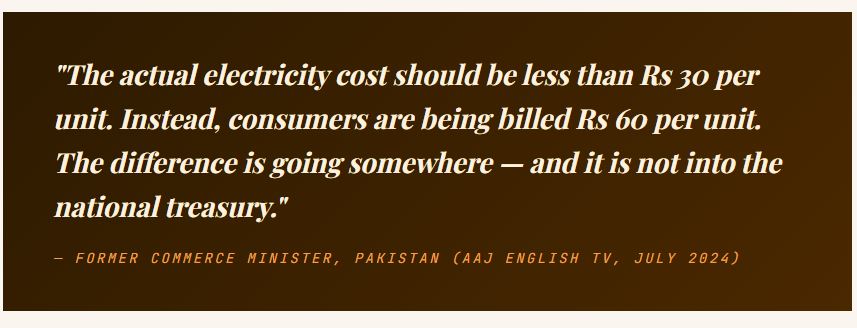
The government cannot simply absorb these costs. So it does what governments do: it raises tariffs. Since 2018, the power purchase price has climbed by nearly 96 percent. The base electricity rate shot up from Rs 16 per unit during 2018–2022 to Rs 30 per unit and beyond. In 2026, middle-class households are facing proposals that could raise their bills by 50 percent more.
According to research by Pakistan's own Planning and Development Institute (PIDE), approximately 30 to 35 percent of the electricity bill that every Pakistani pays today is not for energy at all. It is for debt repayment and inefficiency charges. People are literally paying for the government's financial mismanagement every time they switch on a light.
- Families are cutting back on food and children's education to pay electricity bills
- In August 2023, traders launched a nationwide market shutdown in Lahore, Karachi, and Peshawar over unaffordable bills — covered live by Al Jazeera
- The caretaker Prime Minister at the time told protesters: "There is no second option" — meaning people simply had to pay
- Consumers using 100–300 units monthly — the majority of paying households — faced rate increases of up to 76% due to new fixed charges
- Even the lowest-income households using just 1–100 units per month were hit with new fixed charges jumping from zero to Rs 400
- Industrial production has become globally uncompetitive because Pakistani factories pay far more for electricity than their regional rivals
The impact goes beyond household bills. High electricity costs have pushed Pakistan's exports — particularly textiles — out of competition in global markets. Every time tariffs rise by one percent, manufacturing exports decline. Foreign investment dries up. Jobs disappear. The electricity crisis has become an economic crisis.
Meanwhile, the circular debt — the financial black hole at the center of Pakistan's power sector — crossed Rs 3 trillion by early 2024. Distribution companies cannot pay power producers. Power producers cannot pay fuel suppliers. Fuel suppliers stop deliveries. Plants shut down. Load-shedding increases. And consumers pay more for less electricity.
Section 05
Government Attempts to Fix the Problem — Too Little, Too Late?
The government has tried to renegotiate these contracts multiple times. In 1998, 2012, 2020, and again in 2024, officials sat across the table from IPP owners and tried to rewrite the deals. Each time, progress was limited. The IPPs have powerful legal teams, international arbitration rights, and — critics allege — political connections that protect them.
In October 2024, the government took a more aggressive step. It terminated contracts with six major IPPs — including HUB Power, Lalpir Power, Pakgen Power, Rousch Power, Saba Power, and Atlas Power — with effect from October 1, 2024. In January 2025, revised agreements were approved with 14 more IPPs, projected to save Rs 1.4 trillion over the life of those contracts.
| Action Taken | Year | Outcome |
|---|---|---|
| First renegotiation attempt | 1998 | Failed — HUBCO took government to international arbitration |
| Second renegotiation | 2012 | Limited results; circular debt kept rising |
| Power Sector Inquiry Report | 2020 | Exposed deep-rooted problems; little follow-up action |
| 6 IPP contracts terminated | Oct 2024 | Projected savings of Rs 411 billion |
| 14 IPPs revised agreements approved | Jan 2025 | Rs 1.4 trillion savings over contract life; Rs 137bn/year |
| 17 IPPs moved to "Take and Pay" model | 2024 | Saved Rs 1.1 trillion — but large IPPs excluded |
The current effort is being driven partly by IMF pressure. Pakistan's $7 billion bailout programme requires the government to reduce the circular debt and bring down electricity costs. A government task force is reviewing over 100 power plants. Some IPPs have agreed to take lower tariffs. Others are resisting.
But critics say these measures only scratch the surface. The largest and most powerful IPPs — the ones with the biggest contracts and the deepest political connections — are mostly untouched. And the contracts signed under the CPEC umbrella with Chinese companies are an entirely separate and even more complicated problem.
Section 06
Is There a Way Out? What Pakistan Must Do
There are signs of change. By 2025, roughly 25 percent of Pakistani households had adopted solar power in some form, driven entirely by desperation over unaffordable grid electricity. Net-metering schemes allow some households to sell solar power back to the grid. But this solution is available only to those who can afford the upfront installation cost — which can exceed one million rupees for a full system with batteries.The poor cannot escape. They remain entirely dependent on a grid that charges them more and delivers less. The solar revolution in Pakistan, as Al Jazeera noted in 2026, is a middle-class and upper-class privilege — while the bottom half of the population continues to suffer under IPP-inflated bills.
What does genuine reform look like? Experts and economists agree on several key steps:
- End "take-or-pay" contracts: Switch all IPPs to "take-and-pay" — meaning the government only pays for electricity actually consumed
- Full transparency in renegotiations: Publish all IPP agreements publicly so citizens and Parliament can scrutinise the deals
- No new IPP licenses after existing contracts expire: Let old deals die and do not renew them
- Invest in transmission upgrades: Pakistan loses 16–17% of electricity in transmission and distribution losses — fixing this alone saves billions
- Prioritise renewables: Shift the energy mix toward hydroelectric, solar, and wind — indigenous sources that don't require dollar-denominated payments
- Hold the accountable accountable: Investigate who signed these deals, who benefitted, and who must face legal consequences
The government's own project pipeline shows 84 percent of new planned capacity is in clean and renewable energy. That is a hopeful sign. But hope does not cancel the contracts that still run until 2050.
Conclusion: The Bill Always Comes Due
Pakistan's IPP crisis is not a natural disaster. It was not inevitable. It was built, brick by brick, contract by contract, through decades of poor decisions, weak governance, and outright greed — by governments that came and went, leaving the people to pay the price.
The 1994 Power Policy was supposed to solve an electricity shortage. Instead, it created a financial time bomb. The 2002 policy added more explosives. The CPEC deals added yet more. And today, millions of Pakistani families sit with bills they cannot afford, in homes that lose power for hours every day, wondering why a country with 46,605 megawatts of installed capacity cannot keep their lights on.
The answer is not technical. It is political. It is about who has power — not megawatts, but real power — in Pakistan. The IPPs have it. The ordinary consumer does not.
Until Pakistan's government finds the political will to truly confront these contracts — not just nibble at the edges — the deals signed in the 1990s will continue haunting millions of people who had no say in any of it. The power plants were built for profit. The bills were designed for the people. And the people are still paying — in electricity charges, in inflation, in poverty, and in a future mortgaged long before they were ever asked.
Pakistan deserves better. Its people have waited long enough.